When an industrial humanoid operating in an automotive stamping plant drops an unmodeled stamping blank or encounters novel specular reflections, dispatching human software engineers for on-site diagnostic extraction is fundamentally unscalable across fleets of thousands of deployed units.
Pioneered by Tesla, NVIDIA, and Figure AI, the production standard for enterprise physical AI is an automated, five-stage closed-loop MLOps lifecycle.
1. The Closed-Loop Physical AI MLOps Architecture
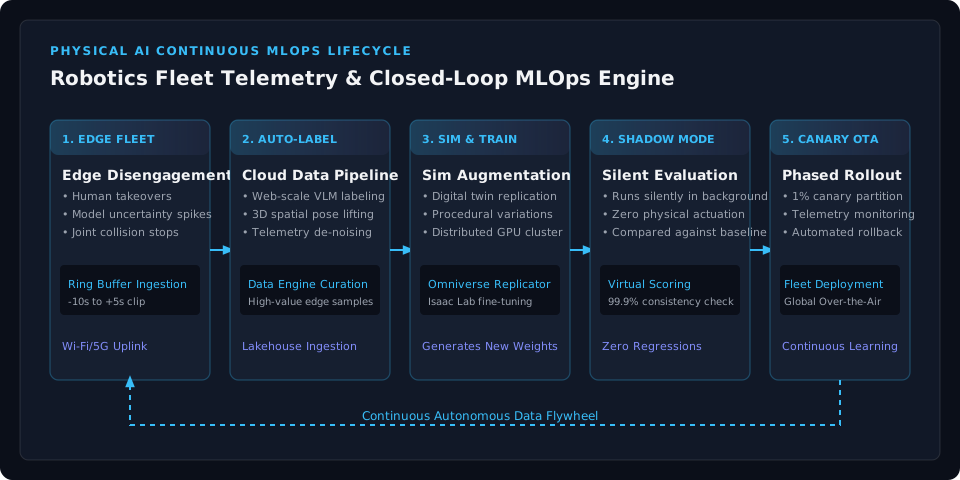
[1. Edge Telemetry Trigger] ──> Human takeover / Collision impulse ──> Compress 15s ring-buffer
                                                                            │
[2. Cloud Ingestion]        <── Foundation VLM auto-annotation & 3D lifting ┘
         │
         ▼
[3. Simulation Augmentation]──> Procedural variation inside Omniverse digital twins & retraining
         │
         ▼
[4. Shadow Mode Scoring]    ──> Silent background execution on edge fleet (Verify 99.9% consistency)
         │
         ▼
[5. Canary OTA Deployment]  ──> 1% -> 10% -> 100% staged wireless rollout with automated rollback
2. Comparing Legacy Industrial Robotics vs. Physical AI MLOps
| Architectural Dimension | Legacy Industrial Robotics (SI Custom Code) | Cloud-Native Physical AI MLOps Flywheel |
|---|---|---|
| Fault Detection | Manual plant worker trouble tickets | On-device NPU uncertainty & torque violation triggers |
| Data Ingestion | Manual technician USB dump on factory floor | Selective 5G/Wi-Fi uplink of compressed incident clips |
| Data Processing | Outsourced manual annotation (Weeks of latency) | Cloud VLM automated labeling & synthetic expansion |
| Retraining Cycle | Annual custom firmware revisions | Continuous weekly CI/CD model training pipelines |
| Pre-Release Testing | Limited bench tests on a handful of prototypes | Fleet-wide shadow mode validation across millions of hours |
| Field Deployment | Physical technician flashing individual controllers | Automated global Over-the-Air (OTA) firmware delivery |
3. Trigger Mechanisms for High-Efficiency Edge Telemetry
A single humanoid platform generates close to 1 Terabyte of multi-view video and proprioceptive data daily. Ingesting raw streams across a 1,000-robot fleet would require petabyte-scale daily bandwidth.
To circumvent network saturation, on-device watchdog daemons monitor three deterministic trigger conditions:
- Human Disengagement & E-Stop Interventions:
- Activated when a safety operator hits a physical emergency stop or a teleoperator seizes remote control.
- Policy Entropy / Uncertainty Spikes:
- Occurs when the softmax action distribution of the Vision-Language-Action (VLA) policy flattens, indicating the model lacks confident physical priors for the observed scene.
- Dynamics & Contact Force Mismatches:
- Triggered when 6-axis force/torque sensor readings deviate by more than 30% from the internal latent world model’s expected contact force, indicating an unmodeled slip or impending structural collision.
The instant a trigger trips, an embedded ring buffer extracts 10 seconds prior to and 5 seconds following the event, streaming highly compressed AV1 video and Protocol Buffer telemetry over local plant Wi-Fi 6E or private 5G networks.
4. Shadow Mode Verification and Canary OTA Rollouts
Deploying unverified neural policies directly to high-torque humanoid actuators in heavy industrial cells poses unacceptable workplace safety hazards.
Shadow Mode Execution
New policy candidate checkpoints are flashed to fleet silicon but operate strictly in shadow mode—disconnected from CAN-FD motor buses. The active legacy controller governs physical kinematics, while the shadow model predicts virtual joint trajectories in parallel.
- Cloud telemetry monitors divergence between the candidate model and active human demonstrations, verifying that the new policy eliminates edge failures without causing regressions on baseline tasks.
Phased Canary Deployment
Once passing statistical shadow gates, firmware is pushed to a 1% canary partition of the active fleet. Telemetry monitors thermal dissipation, cycle completion times, and tracking errors in real time. Any anomaly triggers instantaneous, autonomous rollback to the prior verified firmware within milliseconds.
Without this cloud-native MLOps architecture, physical AI cannot scale beyond artisanal lab demonstrations into high-uptime enterprise manufacturing.
For hardware requirements governing edge neural execution, see our Edge Hardware Sizing Guide for On-Device VLA Models.