Under national industrial roadmaps targeting 80% robotics component self-sufficiency by 2030, South Korea is systematically de-risking its reliance on foreign subcomponents. As embodied physical AI transitions from research benches to automotive and semiconductor shop floors, we analyze the Technology Readiness Levels (TRL) and global cost structures of South Korea’s robotics component value chain.
1. South Korean Robotics Supply Chain Tier Structure
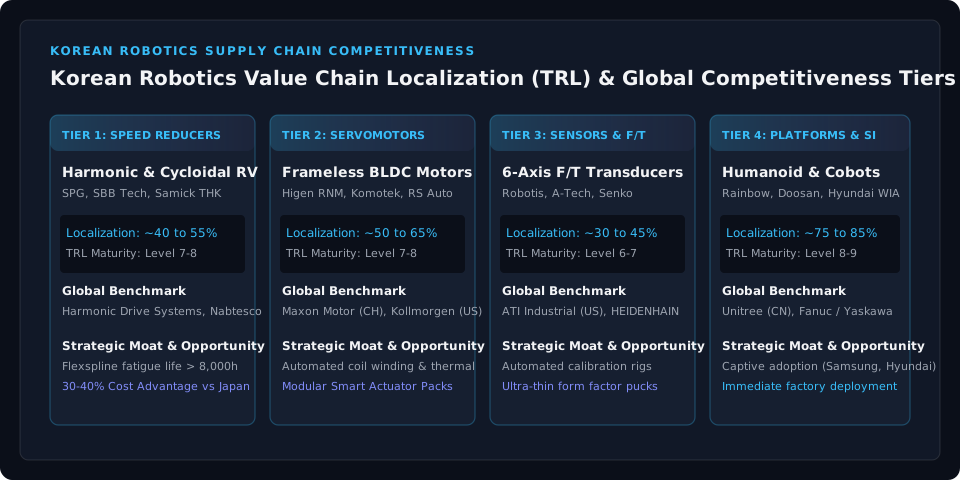
[Tier 1: Precision Reducers]  ──> SPG, SBB Tech, Samick THK (Localization 40~55%, TRL 7~8)
[Tier 2: Servomotors & Drives] ──> Higen RNM, Komotek, RS Automation (Localization 50~65%, TRL 7~8)
[Tier 3: Sensors & Feedback]  ──> Robotis, A-Tech, Senko (Localization 30~45%, TRL 6~7)
[Tier 4: Integrated Systems]   ──> Rainbow Robotics, Doosan Robotics, Hyundai WIA (Localization 75~85%, TRL 9)
2. Quantitative Benchmark: Korean Suppliers vs. Global Incumbents
Data as of October 2026, compiled from corporate disclosures and Ministry of Trade, Industry and Energy (MOTIE) evaluations.
| Component Category | Leading Korean Suppliers | Global Market Benchmarks | Localization Est. (%) | Technology Readiness (TRL) | Technical & Cost Comparison vs. Global Leaders |
|---|---|---|---|---|---|
| Precision Reducers (Harmonic / RV) | SPG, SBB Tech | Harmonic Drive Systems (JP), Nabtesco (JP) | 40% ~ 55% | TRL 7~8 (Active production trials) | • Accuracy: 90~95% parity with Japanese benchmarks • MTBF Life: Reaching ~7,000 to 8,000 hours vs. 10,000h • Cost: 30% ~ 40% price advantage vs. Japan |
| Frameless BLDC Motors | Higen RNM, RS Auto | Maxon Motor (CH), Kollmorgen (US) | 50% ~ 65% | TRL 7~8 (Mass-production pilots) | • Torque Density: ~90% parity with Maxon • High-temp winding automation scaling rapidly • Cost: 25% ~ 35% discount vs. European imports |
| 6-Axis F/T Transducers | Robotis, A-Tech | ATI Industrial Automation (US), Wako (JP) | 30% ~ 45% | TRL 6~7 (Factory pilot testing) | • Linearity: 85~90% of global standard • Packaging: Rapid iteration on ultra-thin wrist form factors • Cost: Over 40% capital savings vs. ATI |
| Integrated Robot Platforms | Rainbow, Doosan, Neuromeka | Unitree (CN), Fanuc / Yaskawa (JP) | 75% ~ 85% | TRL 9 (Commercial export maturity) | • Industry-leading collaborative robot safety certifications • Tailored for cleanroom and automotive integration |
3. Engineering Bottlenecks in Scaling Domestic Autonomy
- Specialty Metallurgy & Vacuum Carburizing Heat Treatment:
- The flexible cup (flexspline) in a harmonic drive undergoes billions of cyclic elastic reversals. Japanese market leader HDS benefits from 50 years of proprietary metallurgical alloy formulations. Korean manufacturers, collaborating with steelmaker POSCO, have localized high-strength alloy compositions to close the fatigue life gap.
- Automating Strain Gauge Micro-Assembly:
- Manually bonding micro-strain gauges onto multi-axis transducer cross-beams introduces batch-to-batch measurement variance. Domestic sensor developers are transitioning to MEMS semiconductor deposition, slashing sensor calibration takt times by more than 60%.
- The Shift to Integrated Modular Actuator Packs:
- Sourcing discrete motors, gearboxes, absolute encoders, and inverters creates bulky wiring harnesses and parasitic weight. Leading domestic suppliers are forming joint development consortiums to package motors and cycloidal reducers into unified, sealed smart actuator cans.
4. Captive Factory Adoption as a Strategic Testing Moat
The decisive structural advantage enjoyed by South Korea’s robotics value chain is direct access to the world’s most automated semiconductor, battery, and automotive mega-factories:
- Samsung Electronics & Rainbow Robotics: Following Samsung’s strategic equity investment, Rainbow Robotics has systematically deployed humanoid and collaborative arms across semiconductor cleanrooms, accumulating thousands of real-world operational hours.
- Hyundai Motor Group Domestic Supplier Pipeline: To support Boston Dynamics’ long-term manufacturing deployment, Hyundai is qualifying domestic precision reducers and servomotors from SPG and Higen RNM across pilot cells, driving down supply chain import risks.
By pairing cost-competitive manufacturing with high-density industrial testbeds, South Korea’s robotics ecosystem is positioned as a primary high-reliability hardware manufacturing partner for the global physical AI wave.
For further mechanical teardowns of precision gearing mechanisms, read our analysis on Robotics Gear Reducers: Harmonic Drive vs. Cycloidal vs. Planetary.