Prior to 2024, bipedal humanoid prototypes routinely carried price tags exceeding $150,000 to $250,000. That economic reality was shattered when Hangzhou-based Unitree began commercial global shipments of its dynamic G1 humanoid for $13,500—the price of a budget compact car.
Mirroring DJI’s dominance in consumer drones and BYD’s rapid expansion across electric vehicles, we analyze how China’s vertical manufacturing cluster achieved this price disruption and assess its geopolitical and industrial consequences.
1. US-China Physical AI Supply Chain Decoupling Map
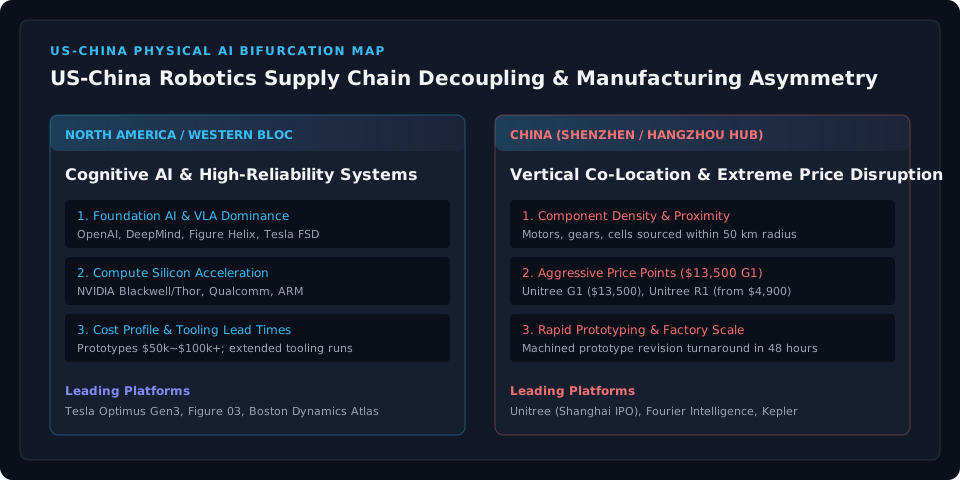
[North America / Western Bloc]                     [China (Shenzhen / Hangzhou / Shanghai)]
• Cognitive AI Hegemony (OpenAI, Gemini)           • Co-located Component Supply Chains (<50 km radius)
• Accelerated Edge Silicon (NVIDIA Thor / Blackwell)• Aggressive Unit Price Floors (Unitree G1: $13,500)
• Rigorous Functional Safety (ISO 10218, PL-d/e)    • Turnaround from CAD to CNC prototype within 48h
• Prototype Costs: $50,000 to $150,000+            • Surging global academic and open-source adoption
2. Anatomy of Unitree’s Price Disruption: Vertical Integration
| Subsystem Component | Western Robotics Startup Sourcing | Unitree In-House Vertical Sourcing | Cost Reduction Delta (%) |
|---|---|---|---|
| Joint Motors & Reducers | Imported Maxon motors & Japanese HDS units ($1,500~$3,000/joint) | Proprietary M107 outer-rotor motors + in-house planetary gearing | 70% ~ 80% Reduction ($200~$400/joint) |
| Battery Packs & BMS | Custom low-volume outsource packaging | Standard 18650/21700 cell domestic supply + in-house BMS | > 50% Reduction |
| Structural Chassis | 5-axis CNC machining job shops (Multi-week lead time) | Direct die-casting & rapid CNC tooling clusters (48h turnaround) | ~60% Reduction |
| Locomotion Policy Software | Costly commercial enterprise tooling | Open-source Isaac Gym RL models fine-tuned in-house | Development time halved |
Unitree is not an integrator of off-the-shelf components. From copper coil winding to permanent magnet positioning and gear tooth broaching, every mechanical link is manufactured within a 50-kilometer radius of its Hangzhou headquarters, compressing design iteration cycles down to 48 hours.
3. The Shanghai IPO and Capital Scaling
Unitree’s 2026 listing on the Shanghai STAR Market solidified China’s aggressive robotics scaling strategy:
- Issued at 150.80 RMB per share, the company raised 6.1 billion RMB (~$905 million USD).
- Establishing an annual manufacturing throughput exceeding 5,000 units created self-reinforcing economies of scale, applying further downward pressure on component supply pricing.
4. Geopolitical Bifurcation: Data Security and Industrial Safety Gates
Faced with an influx of low-cost Chinese humanoid platforms, Western regulators and automotive OEMs are erecting formidable commercial barriers:
- National Security & Sensor Data Ingestion:
- Modern humanoids carry 8+ cameras, depth sensors, and spatial microphones. Under the US National Defense Authorization Act (NDAA) and Commerce Department export rules, foreign-manufactured autonomous physical agents are barred from critical infrastructure, defense manufacturing, and sovereign chip fabs.
- Functional Safety & ISO/CE Compliance:
- While Chinese units excel at agile gymnastics and outdoor running demos, satisfying strict collaborative robotics mandates (ISO 10218, ISO/TS 15066 Power and Force Limiting) requires deterministic certified safety PL-d architectures that remain absent in budget platforms.
- The High-Reliability Enterprise Moat:
- Western champions (Tesla, Boston Dynamics, Figure) focus on “NVIDIA Jetson Thor silicon + certified high-reliability hardware”, offering zero-defect guarantees for 24/7 automotive line installations.
The physical AI ecosystem is bifurcating into two distinct spheres: low-cost Chinese platforms dominating educational research and price-sensitive domestic logistics, versus certified Western architectures governing mission-critical Western enterprise manufacturing.
For an exhaustive component-level bill-of-materials breakdown, review our Humanoid BOM Cost Teardown Analysis.